Posts

Working with small groups

Image
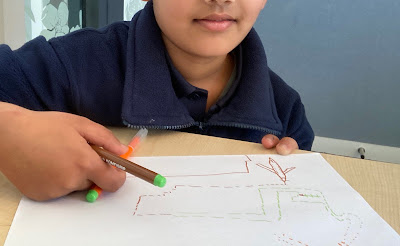
I feel so lucky to be learning so much from the kids that I teach.  Two of our students taught me new games that they had played during their art therapy time.  The first game involves drawing 6 doodles / scribbles / shapes and numbering them 1-6.  Then each person takes a turn to roll a die.  If the die lands on a 6, that person copies the doodle that is labelled '6'.  This continues until one player draws all 6 doodles on their paper.  The game seems to help students take turns and interact positively with each other while also creating a drawing in a structured way.  Another drawing game involves drawing a large circle or square (over most of the paper) and dividing it into parts. If there are 3 players, divide the shape into 3 parts. If there are 4 players, divide the shape into 4 parts. Decide how many minutes you will get to draw your first picture (1-3 minutes seems good). Then each person draws their first picture in one of the sections. Then w...


Art Therapy

Image
Today, I had the opportunity to join with Maggie (an art therapist) while she worked with one of our students.  It was such a valuable and fascinating learning experience. I was a bit nervous - I didn't want to say the wrong thing! I needn't have worried.  1. Feelings scale 1-10 with colours to represent the feelings. We drew the scale together. We discussed how we were feeling at that moment. Maggie emphasised that all the emotions are ok and important. We talked about where we were sitting on the scale when we woke up in the morning. Maggie talked about what she noticed her body doing (eyes feeling heavy) when describing where she was on the scale.  2. Emotions cards. Maggie talked about emotions using cards from Inside Out 2 (the movie). She explained that, like the primary colours, base emotions can get mixed to create new emotions. For example, anxiety can be a mix of fear, anger and sadness. The base emotions are joy, anger, sadness, disgust and fear. Maggie asked o...

Mega Meet - Equity and Success for All

Image
  For the first time in my teaching career, I was part of a conference that included Primary, Intermediate and Secondary teachers from the local area. Waiting outside for the powhiri to begin, I was excited to see a lot of colleagues I knew from 12 years teaching in this area. I also had the chance to meet new people.  The powhiri was really special - listening to the speeches and singing waiata, I felt the sense of unity - he waka eke noa - we're all in this together.   To add to my excitement - Russell Bishop was the key note speaker. The focus of his work is really close to my heart - developing teaching approaches that are highly relational, while also having very high quality teaching interactions with students.  Here are some key points that I took from Russell Bishop's address...  - When students are achieving at a lower level than expected, teachers often seek to explain it by saying there is a problem with the child/family/society.  - A more c...

Mini Meat - Best Start Literacy

Image
  In Term 1, I attended a Mini Meet at Drury School to find out more about their journey with BSLA.  BSLA (Better Start Literacy Approach) is based on a structured literacy approach along with oral language, whanau engagement and comprehension.  Disclaimer: I'm not a fan of structured literacy - mostly because I believe in reading for meaning and enjoyment, not reading for decoding.  However, I find it really helpful to have a consistent plan that I can follow - and BSLA seems like a thoughtful, systematic approach that covers core learning skills.  One of the most helpful ' takeaways ' for me, was the use of high quality picture books, with multiple readings. Also, substituting some of the English words for Māori kupu... what a great way of including te reo within a familiar context.  I was impressed to hear about the equitable outcomes it was achieving across the spectrum of learners.  Recently, I heard Russel Bishop discussing the use of Balanc...

Circle Time - Peer-to-Peer Conversations

Image
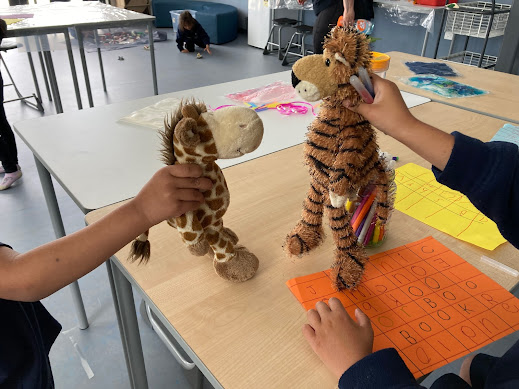
  As part of my professional learning I am working towards this goal:  By Week 5,  try some different ways of promoting peer-to-peer conversations during 'making time' so that our students felt comfortable sharing their ideas with their peers. The early childhood resource "Talking Together" from the Ministry of Education gave me some great tips: Environment :  - Provide activities that are creative and open.  - Choose activities that connect with the students culture and experiences - Small groups are most helpful for encouraging talk - The spaces should be calm and quiet without background music  Teacher prompts:  - Listening to a child talk and then responding with, "That reminds me of a time… does it remind you of a time…. " - Story telling - listening to a child’s story, recording and retelling (possibly with prompts) with other children joining in.  "That’s an idea I hadn’t thought of George. Has anyone got a different idea?" Using puppets to...

Māori and Pacifica Giftedness

Image
Māori and Pacifica Giftedness  Workshop facilitated by Melissa Powell, Rosehill College  Image by  Thomas Wilken  from  Pixabay     I'm publishing this post that I wrote in September but didn't come back to.  Coming into this workshop and taking the self-evaluation I realised I knew very little about Māori and Pacifica giftedness - in-particular how giftedness is seen in these cultures.  I have this habit of projecting my understanding onto another culture and thinking it works the same way for them too!!  (Seems to be a bit of a pattern as it happens in other areas too... that's why these workshops are so important because they wake me up and help me to see through another window)  What I loved about this workshop was that it taught us about finding the strengths of our Maori and Pacifica learners and see these strengths through their eyes.  Here are some quotes from the videos we watched... ...giftedness is about leadership ...

Circle Time - Professional Development Cycle

Image
 Circle Time - Professional Development Cycle  I have enjoyed meeting with Gretchen twice to discuss my professional goals for this year.  We decided that the context for my professional learning would be small-group circle times (which I help to facilitate twice a week).  I attained some baseline data by collecting an audio recording of my conversation with some of the students while they were doing their art. I was being conscious of using teacher talk moves: - repeating back what a student is saying  - giving wait time  - saying, "tell me more"  The conversation I had, mainly with M, was extremely interesting. He was discussing a number of deep topics that came from his art - an island. From this came a discussion about religion, politics and how people treat him.  This really showed me how art can open up conversations with students and allow them to talk about things that they have on their mind and topics that are important to them.  Gr...

Writing Programme

Image
  The Mini-Meet that I went to was by Ella Sharma at Papakura Central School.  Three takeaways:  - student ownership of learning  - students being able to articulate their learning - having a meaningful purpose for writing  This workshop prompted my thinking, "Why is it important for me to be an excellent practitioner in teaching writing??" These ideas come to mind... - Writing is about giving kids a voice (student ownership)  - Writing is about valuing the voice of students (meaningful writing purposes)  - Writing is an important transferrable skill to successful live in our society (knowledge/skill transfer)  Which makes me think... when our kids leave Year 6 - what would they be doing... - confidently delivering speeches and reports on topics that are important to them  - presenting original spoken word poetry or rap  - sharing their stories and the stories that they want to read - uplifting others through their stories, giving voice ...

Reading Observation with Hilton from SHARP Reading

Image
Picture from GDJ on Pixa Bay:  Hilton observed me working with the Year 4/5/6 Stage 3 Group, which I am taking every Monday.  Hilton's feedback to me included:  - I had a good grasp of the SHARP routine  - Next, facilitate the students actively participating to a greater degree  - I was still doing most of the heavy lifting (in terms of the teaching and thinking).  - The whole class routine needs to be tighter, stopping for behaviour management drags it out - I was using a lot of 'soft behaviour management strategies' - noticing the kids who were involved, redirecting those off task - but these strategies were not effective. - Get the group closer together (kids sitting away from the group is the first step to disengagement) - Stick to the unpacking sentences and a thumps up for feedback  I was very grateful for Sam and Michelle helping me to manage the group so I was able to get the most out of the session with Hilton.  I found the feedback very ...

Mind Over Manner

Image
  Look for Connection, Find the Connection, Stay Connected, Support the Connection  "Connection" and "observation" were the takeaway messages I took from our session with Sue and her team of actors, as they taught us us about neurodivesity through theatre.  Sue Haldane introduced us to a kupu in te reo: takiwātanga which means "in their own time and space." This is the Māori word for autism or those who show neurodiverse ways of being.  I find this word really helpful.  A word that lets people be who they are. It doesn't draw a box around someone like so many labels do.  These sessions with Sue and her team were emotional! Not that I cried, but I went home feeling like I had experienced all these intense emotions - because we had been experiencing what it is like to be in the shoes of a neurodiverse student and to teach neurodiverse students.  Of course it also brought back a lot of memories. Hard memories. Students. Experiences of meltdowns (my own an...

NZ Histories Call Back Day

Image
Image by  anncapictures  from  Pixabay   Tamsin Hanly talked us through her Curriculum Programme Resource (CPR) for teaching NZ histories.  I appreciated Tamsin sharing her story. As a 15-year-old she was really affected by the Bastion Point protests and delved into the stories leading up to this protest. She was shocked that there was so much about NZ history that she was never taught and never aware of. That set her off on a journey to learn more about NZ history and become a teacher, academic and writer to share what she learned with others.   I relate, because as a high-schooler I listened to all the news reports about the Foreshore and Seabed issues and I completed a school project on it. I also was shocked at the injustice, the mis-information and the missing information. It was probably at that point that I started to question the "NZ Standard Story". From my perception this is a cultural narrative that says (in a nutshell) that Māori are to bla...

NZ Histories PLD - Part 2

Image
  Image by  kewl  from  Pixabay   More stories... (yay)...  This time about...  Nga Tupuna - Ancestors  - Tāwhaki was hurt and buried by jealous relatives but came up again and with the help of his wife was healed/restored. Ponaturi (sea faries) capture his parents, kill his father and enslave his mother. Tāwhaki and his brother, Karihi, search for their parents, find their grandmother, trick the Ponaturi and rescue their mother.  Some stories say that Tāwhaki's great bravery and beauty attract Tangotango, a magical woman from the heavens, and she makes nightly visits to him and becomes his wife.  When their daughter is born, Tangotango asks Tāwhaki to wash the baby, even though it is normally the role of mother to wash a daughter. Tāwhaki says the baby smells which is an insult and Tangotango goes back up to the heavens with their daughter.  Tāwhiki then goes through difficulties to ascend to the heavens. He pretends to be a slave ...

Quality Circle Time Part 1

Image
  I liked this thought from the introduction... Teachers need their own good practise modelled back to them.  The introducer said that the Quality Circle Time model reflects back to teachers much of their best practise... many of the things they already do within a framework.  To be honest, I came into this book thinking that Circle Time is a bit cheesy. I didn't have a chance to do the professional development last year, so I've got a bit to catch up on.  Possibly Jenny Mosley has done a very good sales pitch. Or otherwise she is really onto something that connects with a lot of things I've been thinking about lately.  Dialogue. An open forum. Listening. Routine. Feedback circles.  These are some of the key components that I have taken from the book so far.  I'm interested in how it interacts with the Golden Rules and Golden Time. At our school we have focused on Quality Circle Time, we have school values which are similar to the Golden Rules, but we ...

NZ Histories PLD Te Orokohanga - Māori Creations

Image
                                                                            Who's story?? Stories are powerful.  To hear a story is to interact with it.  Stories invite us to find ourselves within them.  Stories invite us... they put forward ideas such as...   "think of yourself this way,"  "this is how the world works..."   And we accept, reject or change these ideas.  I think creation narratives are some of the most important stories that frame how we see ourselves.  I've noticed that in NZ we live in a very secular culture and the dominant culture (as a whole) shows little interest or understanding of creation stories and world views. As a whole, NZ society seems to accept a scientific 'creation story' of an evolution of matter and energy devoid of...

LifeKeepers Course

Image
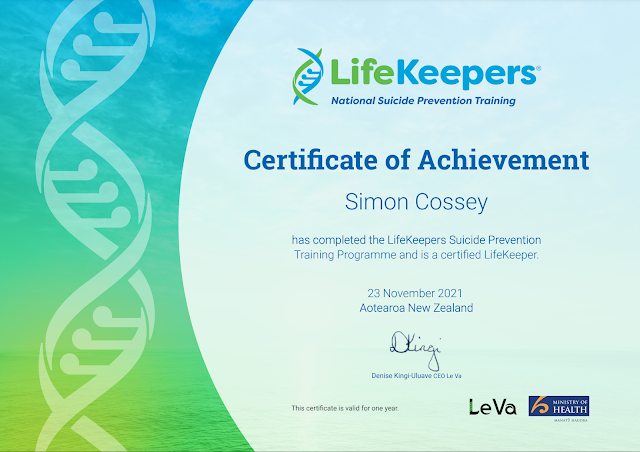
  A very valuable short course. Thanks Michelle and Alida for the recommendations. I now understand about warning signs. I also feel more confident that, if needed, I could talk to someone who might need support. 

Returning to School Through Love and Care

  Here are a few snippets that I took from the webinar along with my reflections.  Carol Mutch: Schools hold communities together as an anchor (keep people connected).  Principals and teams can become community leaders who step up in a crisis. Teachers become front line trauma workers.   Reflection: Communication is such a key part of this. Sharing timely information, reassuring people and giving practical direction to solve the problems, providing people with a focus.  Take the support offered to you. Be kind to yourself.  Reflection: I'm really grateful for the professional supervision offered by PES. I've had to be kind to myself by not expecting myself to complete 10 extra things while in lockdown. One thing might be manageable and I'm trying to include things that restore me.  Students will all come back in different places.  Share critical hope... So knowing your learner is really important. I like the phrase critical hope... to me, it speak...

Bruce D Perry

Image
Bruce D Perry just blew my mind!! I watched this video and it really resonated with me.  I've been reflecting on it and making connections and letting it really get into my imagination.  A few key points that I took from it:  Perry started his talk with this quote:  - The proper time to influence the character of a child is about a hundred years before he is born. William Inge - one of our strengths as human beings is our relational connectedness. Throughout our history this has been essential for our survival. Individuals don't survive. Groups/communities/clans/communities do survive.  - Growing up in a communal family arrangement, a baby would have ration of 4:1 adults interacting with the child. Now, in our early childhood centres we are lucky if we have a ratio of 1 adult to 6 kids.  - Today many people are living alone and many people are living in households with less than 3 people. Throughout much of our history, people lived in households with 20+ p...

Leadership Training Continued

  Leadership Training…  I chatted with Alida about how we could do leadership training online again in Term 4 and make it available for more students. We decided to include some of the Year 5 students and provide them with leadership training opportunities that would help them be successful as leaders next year, whether or not they are officially chosen as house leaders. I was really excited about the opportunity to have some of our Year 6 students pass on what they know to our Year 5 students. It makes sense to start this process before the new school year so we are ‘ready to go’ and we can benefit from our Year 6s ‘passing on the baton.’  In our first round of Meets, 12 students attended, made up of 5 current leaders and 7 Year Five students. Seven students were girls and 5 were boys. Year 6 leaders were able to discuss the good and difficult parts of being a leader. They also shared the leadership challenges we had completed together. Repeating this helped to reinforce...

Sharp Reading 3

Image
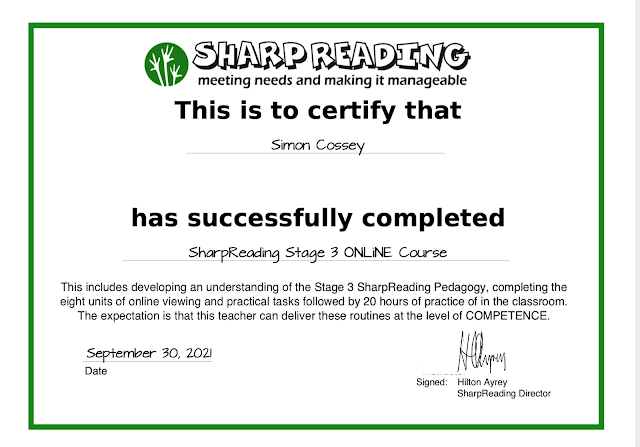
It was really helpful meeting up with my coach twice during lockdown.  Previously, we had set a goal of doing a Sharp Reading observation with the swivel camera focusing on group and whole class management. Of course this went out the window because we're in lockdown. However, we have bumped that across to Term 4. This will fit really well with the Unit 8 focus on increasing fluency.  My coach suggested finishing the online units during lockdown. So I have done that and achieved my certificate!! I haven't completed the 20 hours of practise yet, but I expect to get more practise once we get back to school.  In Unit 6, I learned how to score students accurately (and practised this with my coach). In Unit 7, I learned to teach the vocabulary strategies to clear the roadblocks (and practised this with my coach).  For me, the most important outcome is that I can pick up a Level 3 Sharp lesson and teach it when I'm releasing a teacher. 

Leadership 3

 Leadership 3 I really enjoyed our last Leadership Meets for this term. All the leaders were invited by email and a phone call or text. Again, it was nice to make contact with whānau. Three students came on the calls.  We discussed their leadership 'Leading Self' challenges. When we reviewed the "Levels of Leadership" model, these leaders were starting to recognise the progressions.  For me, one of the great takeaways of these Meets was our discussions about next term. I asked the students for input into our Friday hui, activities and sport. As we had a korero, they were able to add suggestions of activities they would like to lead. K wants to lead dancing (Born to Move) on wet days. L is willing to lead the actions for kapa haka at our hui. 'A' was able to think of other students who would be good leaders for activities and kapa haka and wanted to start recruiting before we even got off the call! He is going to work with a friend to lead a drum group. We disc...