Posts

Netball Workshop with Tracey and Alice
Image
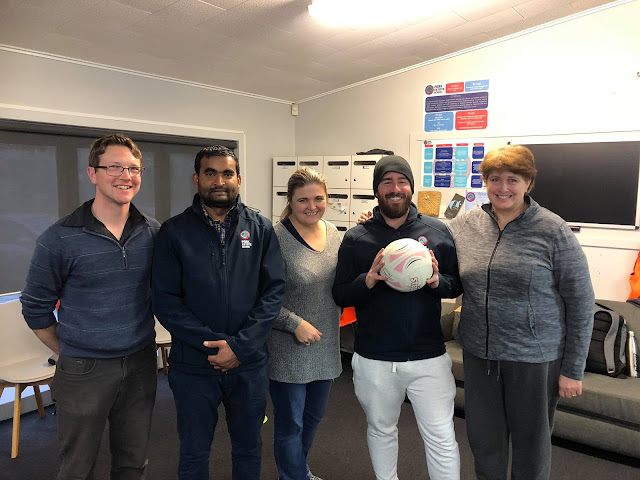
  Somehow the staff room survived without any major damage!!  The wether was very stormy - so we couldn't get outside. Not to worry, we improvised and used the staffroom as our netball court! Hilarious.   Where am I at? I don't know much about netball. I would put myself at 3 out of 10 before we started. Only because I like sport and know some ball skills.  What did I learn?   - coaching by questioning (making the students do the thinking rather than the coach 'telling')... hmmm sounds a lot like dialectic teaching!  - the different adaptations of netball for different ages - kids play sport for fun, teamwork, fair play, learning new skills, (winning is 81 on the list when kids were surveyed)  Reflection   - When I watch kids play games, they often don't keep score. but they will spit fire if someone doesn't 'play fair' according their view of fair. Perhaps fair play really is more important than winning for lots of kids.  Action St...
Toolkit - Smart Media - with Fiona Grant

Image
  Smart Media with Fiona Grant   A recorded toolkit from Oct 19.  My brain is buzzing with the concepts and there are so many ideas to explore in the slides   Focus on Year 1-3.  Learn - students start by learning 'what is media'. This can happen through discussing images of people engaging in different types of media (using technology and tech free), sorting these images and noticing what is happening within these images. In doing this, students are 'tuning in' to the media that is around them.  - Super tip - select images the kids connect to (e.g. murals from around town and DLOs from other kids' blogs).  Students learn that people make images.  Students discuss fake and real images. As you view and evaluate images - you are constantly eliciting questions from students, helping them to think for themselves, encouraging their curiosity.  Create   Students can create their own 'fake' images by using sites such as explain everything...

PB4L w Karen

This is the formula we're working with: Clear expectations, teach the expectations, then run around like crazy reinforcing the expectations.  This results in a safe and predictable environment.  Today one focus is:  Eating times  Defining the Problem... - rubbish - time to get to class - taunts, play ground behaviour continuing  Question: Does watching a screen slow the kids down eating? Or is helping to calm them and give the teacher the time to solve problems.  When you are starting a new routine you need 7 times to practise.  When you are stopping an old habit and starting a new one you need 28 opportunities to practise.  Let the kids know what they are coming back to... "When you come back we are going to have..."  Watching the videos of kapahaka - and practising by the end. Or a video about who is coming in... watching each other.    You could set up a drop in centre during lunch breaks. Kids can come and talk to a teacher abou...

Literacy at PES

Image
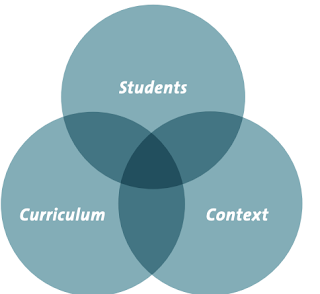
Reading allows students to access the curriculum. When planning we consider... Curriculum - what is to be covered in the New Zealand Curriculum. Students - what are the students needs. Context - how do we connect to the students world. We can start from any of these three and then integrate the others. Guided Reading.  My takeaway -  Provide appropriate scaffolding to allow students to access work at the level they are expected to achieve at.  Action points:  Allow opportunities for students to revisit texts. (buddy reading, independent reading) Discuss the concepts for  comprehension. 

Returning to School with Brenda McPherson

Image
Photo by  Ben White  on  Unsplash Today Brenda helped us to reflect on "Online Teaching" and decide what we want to take from this into our future teaching. There is a sense that there is a 'new normal'. The playing field has changed and we can seize this opportunity to change too. What are our top priorities when the students come back. 1. Whanauatanga. Relationship building and rebuilding. 2. Helping the students feel safe - wellbeing. 3. Routines and expectations One suggestion I really liked was to 'informally' seek people who will be a 'coach.'. Maybe start with the question,  "I think this [idea] would work... can you think of reasons why it wouldn't?" (My wife is pretty good at helping with this question... sometimes she even gets her answer in before I ask!) Action points... Help the kids feel like this: Photo by  Annie Spratt  on  Unsplash Start: - Including play and being ok with it. Harnessing the p...

Coronavirus: Worry, Strees and Anxiety with Michael Hempseed

Introduction:  Michael Hempseed is a popular speaker about mental wellness and the author of the book, "Being a True Hero." He presented a free seminar for principals/leaders/teachers at the start of the lockdown. Keith Tetzlaff shared the  Webinar Link   He also has a TEDx talk about failure. A few points:  - Many people experience a crisis (like Covid-19) and get through fine.  This can be because of the 'protective factors' like positive, stable connections.  Lack of 'protective factors' and more 'risk factors' can mean that kids/adults find it hard to cope.  - Keep boundaries Some parents might be very stressed at this time. Don't take that stress on yourself. Also, be realistic about what you can do. - Hopefulness  Humanity has overcome a lot of challenges in the past, e.g. smallpox. We have successful brought back some species from the brink of extinction (white rhino). Dwelling on the present can be scary. Recogn...

Data Analysis

Data, data data!! To me our data is showing that students need the ability to transfer skills, knowledge and strategies from one context to another. To me, the dialectic teaching approach is really important to this because this encourages the students to think for themselves, to think flexibly, to transfer knowledge. Identifying the gaps... - fractions - measurement - decimals - statistics (especially interpreting statistics). We also discussed the importance of students revisiting previous learning to practise. Our ipads and chromes are ideal for practising concepts until they are solidified. This means that teaching time is not used for practising with students, but for modelling and supporting students with new learning (and engaging in dialectic teaching and learning) The challenge for me is to stop and let the students struggle - just the right amount of struggle - and to achieve success themselves (then celebrate that). Often I dive in to 'save' kids from t...